16 September, 2009

Change in Health education apparatus in India

188px-India_(orthographic_projection).svg
Task Force Report on setting up NCHR in Health

To overcome the acute shortage and uneven distribution of human resources in public health delivery system, the Ministry of Health & Family Welfare aims at overhauling the current regulatory framework. Toward this end, it is proposed to set up a National Council for Human Resources in Health as an overarching regulatory body to achieve the objective of enhancing the supply of skilled personnel in the health sector.

http://www.mohfw.nic.in/nchrc-health.htm
Here is the draft report for initiating Positive changes in our medical education system. 

Some of the ideas mentioned are revolutionary scrapping multiple levels of control and having a standardised post graduation level exam) whereas some are half-assed (like the umpteen administrative functions concentrated in a select few).
 
The general public is invited to go through the report of the Task Force and the draft bill and sent their comments / observations on the suggested provisions by the 15th October, 2009.

http://www.mohfw.nic.in/nchrc-health.htm


Kindly mail your views to make a difference


11 September, 2009

Swine Flu Update: Single-Dose Vaccine Appears to Work

Swine Flu Update:  - We have all been waiting for the ideal swine flu vaccine, and lo, its POSSIBLY Here now.
A Single-Dose Vaccine Appears to Work, Study Shows: "
syringeThe first clinical trial data on new vaccines being developed to treat the H1N1 pandemic flu virus in the U.S. suggest that one dose will work to immunize most people, according to a preliminary report in the New England Journal of Medicine.
Researchers studied two vaccines, one which had a substance added to improve immune response, called an adjuvant, and one that didn’t, for 21 days. Both showed the vaccines elicited immune responses with single shot. One big question for public health officials was whether a single dose would be sufficient.
Full results will be published after patients have been followed for 42 days, the journal said.
An accompanying editorial, written by Kathleen Neuzil of the University of Washington, calls the findings “welcome and reassuring” and suggests that it would be “appropriate” to start vaccination using one regular dose of non-adjuvanted vaccine. Two doses might be needed in children, she writes, but if supplies are short, the vaccine shouldn’t be held in reserve to give a second dose.
The nonadjuvant vaccine is being developed by CSL Ltd. of Australia
The adjuvant version is from Novartis. Both are expected to be available in the fall.
Side effects, including pain at the injection site and headaches, were reasonably tolerated, Neuzil noted.
Chinese vaccine marker Sinovac Biotech and Novartis have both said recently that their swine-flu vaccines showed positive results.

05 September, 2009

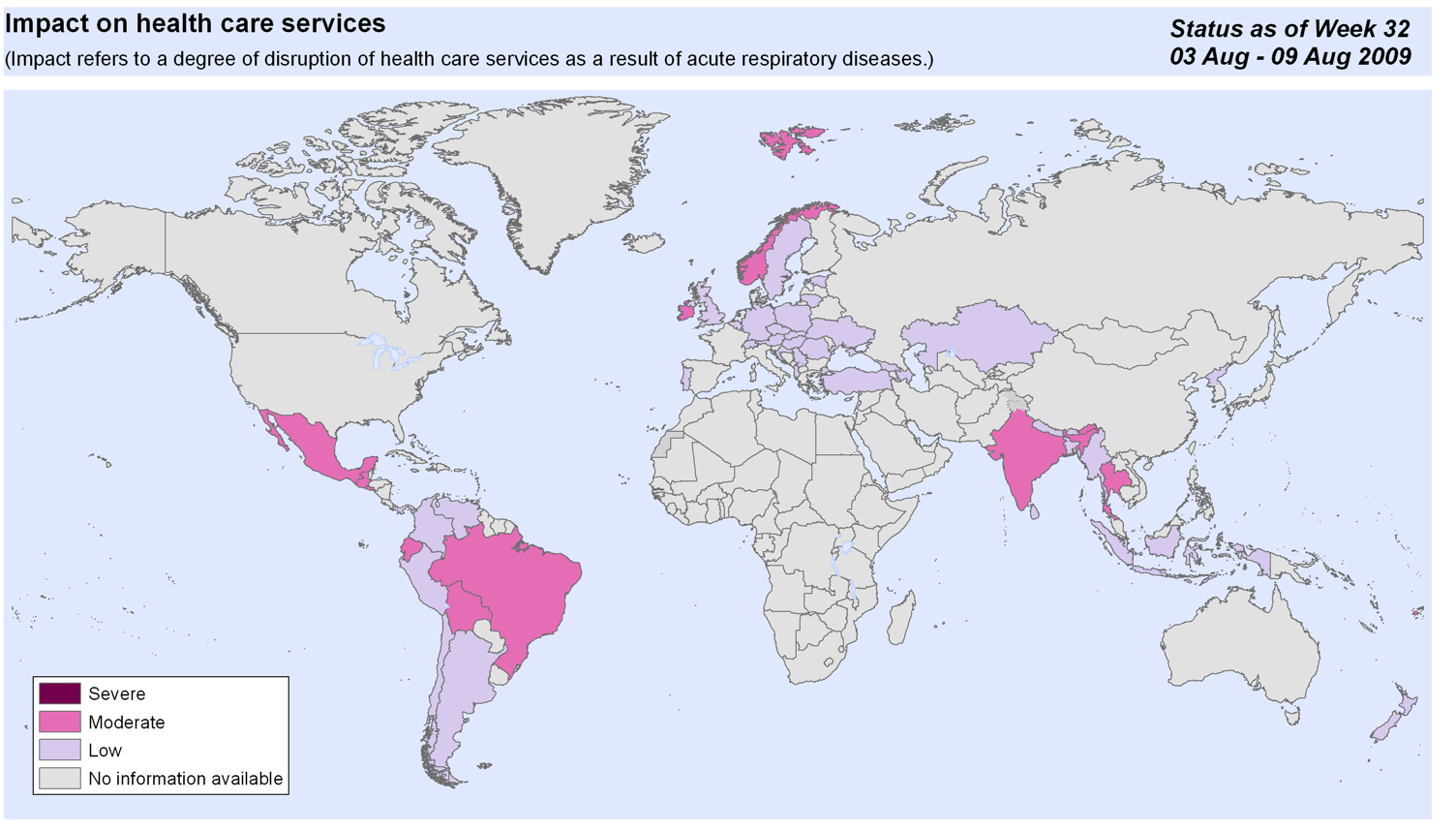
WHO: Impact on healthcare services

Swine flu has now been around for about 6 months.It has caused an alarming impact on health services trying to cope with all thr panicked populations, more so in Developing countries.
Mexico, India, and Central and Southern American countries have born the brunt.
Check the image.
H1N1fluImpact

27 August, 2009

Using Cellphones to diagnose Malaria and Blood disorders

Microscopy provides a simple, cost-effective, and vital method for the diagnosis and screening of hematologic and infectious diseases.It is an essential tool in disease diagnosis and widely used all over the world. Unfortunately, the EXPERTISE required to use the tool, and to evaluate the findings is not very common. One requires a pathologist with many years of experience to make sense of those seemingly random and confused pixels. (I know, i am a pathologist :-)


It takes a lot of effort, and money to train a pathologist, equip him/her with all the instruments required, and then use the skills in a backward area without proper facilities. But the advent of digital imaging has solved many of our troubles. Telepathology made sure that we do not need a pathologist physically present at the site, to render a diagnosis.

But microscopy and digital imaging of the biopsy/tissue fragment was still a hassle. Now we have done better. You don't even need a microscope to send a microscopic image over the network!! Researchers from the Univ. of California worked with high-powered LED – which retails for just a few dollars – coupled with a typical camera phone to produce a clinical quality image sufficient for detecting in a field setting some of the most common diseases in the developing world.


The newly developed technology, CellScope, allows for average cell cameras to be retrofitted with powerful microscopes, able to detect malaria parasites, and even fluorescent marker-stained tuberculosis bacteria.
Thus you have your humble cell-phone transformed into the sherlockian "cell-scope".

“The images can either be analyzed on site or wirelessly transmitted to clinical centers for remote diagnosis. The system could be used to help provide early warning of outbreaks by shortening the time needed to screen, diagnose and treat infectious diseases,” University of California in San Francisco (UCSF)/UCB Bioengineering Graduate Group graduate student David Breslauer adds. CellScope could also provide remote access to digitized health records, and would be amenable to epidemiological studies, using triangulation or global positioning system location data, such that outbreaks could be monitored as they happen.

So maybe i could click a photomicrograph of that mole on my friend"s forearm, twitter it to my onco-pathologist friends, who view it on their smartphones and twitter / message their diagnosis back to me. Simple and fast, especially with my own group of pathologists on the network.


Labels: , ,


Related articles

Posted via email from drneelesh's posterous

Kindle in Medicine


 Kindle is a new device that is changing the face of reading. The best of the current lot of e-book readers, Kindle is a boon for   medical students and professionals, allowing them access to hundreds of books on the go!. The basic functions of Kindle can be seen here.Kindle, now in its third avatar, the Kindle Dx (Deluxe) boasts of more advanced features, like PDF support (experimental)  , longer battery life, 5-way Controller and sleeker design.

Check out more features here.. You can view it from all angles, zoom into any area and look at its features.

Using Kindle in Medicine

  • Easy for medical students to keep up with all their scheduled reading. You can download and read reference materials that you have read previously to refresh your memory.You can seek out new textbooks to look for answers too.
  • Seeking out symptoms, conditions, and other relevant information is easy.You can view photos on the Kindle if you need to see pictures of various signs and symptoms conditions. 
  • Study medical texts and highlight portions of texts / make notes on the Kindle as you go. Zoom into images for micro details.Bookmark and annotate important portions.
  • Research can be done on its built-in web browser ( experimental feature) , no need to carry a laptop to access the internet.It offers free Wireless access to Wikipedia
  • .Multiple books can be read at once, no need to carry a JUMBO Grey"s anatomy or Robbin"s Pathology encyclopedias !! It boasts of storage capacity of 1500 / 3500 books, depending on the Model.
  • You can listen to music while you read.
  • Inbuilt Text-to-Speech feature lets you listen to your favorite books.
It has a clear policy for returning the instrument or any content bought ( within 7 days of purchase) and also One year limited warranty. The kindle library boasts of more than 300,000 books for download, and many more added regularly. Priced at 300 and 500 $$ , and weighing approx. 300 and 500 grams (depending on the model) it is still too pricey for open embracing of this technology. Some libraries have started lending out Kindles ( with preloaded content) to its patrons.

Personally speaking , i can see a lot of content being adapted for Kindle, provided the machine becomes less expensive.
Also , many more wireless features ( like chat, email, videos etc) need to be added. If more such functionality is added to justify its high prices, i expect a LARGE number of medical students turning to Kindle.

Posted via email from Medical Communications

18 August, 2009

New Swine Flu Guidelines

On 14 th august, Friday night, after facing flake for the past two weeks on the bungled handling of Swine Flu epidemic in India, the government has come up with a better set of guidelines.The new guidelines allow ALL doctors to treat for Swine Flu ( earlier only designated hospitals and doctors could treat Swine flu!!)The guidelines were finalized after a five-hour meeting chaired by Health and Family Welfare Minister Ghulam Nabi Azad.

The patients have been categorized as follows:

  • Category A: Patients with mild fever plus cough/sore throat with or without body ache, headache, diarrhoea and vomiting. They do not require Oseltamivir and should be treated for the symptoms mentioned above. The patients should be monitored for their progress and reassessed after 24 to 48 hours by the doctor. No testing of the patient for H1N1 is required. Patients should confine themselves at home and avoid mixing with the public and high risk members in the family.( I agree with this)

  • Category B: (i) In addition to all the signs and symptoms of Category A, if the patient has high grade fever and severe sore throat, he/she may require home isolation and Oseltamivir; (ii) In addition to all the signs and symptoms of Category A, individuals having one or more of the following high risk conditions shall be treated with Oseltamivir: children under five, pregnant women, those above 65 years, those with lung diseases, heart disease, liver disease, kidney disease, blood disorders, diabetes, neurological disorders, cancer and HIV/AIDS; Patients on long term cortisone therapy. No H1N1 tests are required for Category-B (i) and (ii). Such patients should confine themselves at home and avoid mixing with the public and high-risk members in the family.( I think all such cases be tested for H1N1, and antiviral therapy started without delay)

  • Category C: In addition to the symptoms of Categories A and B, if the patient has one or more of the following: breathlessness, chest pain, drowsiness, fall in blood pressure, sputum mixed with blood, bluish discolouration of nails; irritability among small children, refusal to accept feed; worsening of underlying chronic conditions. Such patients require testing, immediate hospitalisation and treatment.( All such patients should be started on antivirals without even waiting for test results!!, its already late!!)


During the meeting, various guidelines and protocols developed by the World Health Organisation, Geneva, the Centre for Disease Prevention and Control, Atlanta, United States, and the National Health Service, United Kingdom, were also discusse

30 July, 2009

Medical consultation on the Move


A new mobile handheld technology developed by mVisum of Cedar Brook, NJ, is been tested. This communication tool boasts of providing off-site cardiologists access to EKGs that can then be used to prescribe immediate treatment.

The Department of Veterans Affairs is testing this new system which seemingly enables fast transfer of clinical data to a smartphone for review within minutes. The mVisum Medical Communication System is stated to be a communication tool which permits health-care personnel to securely receive, review and respond to a patient"s medical data recorded at the point of care. This transfer of information notably takes place through secure HIPAA compliant internet servers, later transmitting it via mobile technology to the smartphone of the physician. More so, this system is also loaded with the ability to be availability aware, so that the patient can refer to another physician in the absence of the original intended physician. The various types of medical data that can be sent through this technique include DICOM images, EKGs, CT scans, MRIs, X-rays, etc. Along with this, textual information relating to the patient may also be included in the message for the purpose of getting a broader idea about the condition of the patient.

View more news videos at: http://www.nbcwashington.com/video.


The process begins with the recording of patient data at the point of care. Point of Care can include the physician's office, medical center, hospital, or anywhere the patient is located and an system is installed.Data is transmitted securely and reliably to the physician's mobile handheld device. The system has advanced technology that allows the system to be availability aware,so that another physician can immediately be contacted if the original intended physician is unavailable.Once received, the physician can review data and securely respond with medical opinion, prescription or other critical orders.