20 July, 2010

Swine Flu Update- 15th July, 2010

As of 12 July, worldwide more than 214 countries and overseas territories or communities have reported laboratory confirmed cases of pandemic influenza H1N1 2009, including over 18337deaths.
 

Vaccines- Governments, foundations and manufacturers have offered contributions of vaccines, ancillary products (such as syringes and safety boxes) and finances to support the donation initiative


Emerging data on Oseltamivir resistance of the virus is also worrying. Geographical distribution of oseltamivir resistance by the WHO regions (as of 14 July 2010) shows high prevalence of resistant virus strains in European, Western Pacific and North American regions (PDF)

Interestingly, 24% of the resistant cases were seen in patients who had taken post exposure prophylaxis.                                


02 July, 2010

Faking Orgasms

Faking orgasm refers to the act of pretending to have an orgasm without actually experiencing one. It usually means simulating or acting out behaviors, such as body movements, vocal sounds, and sequences of apparent intensification followed by apparent release, typically associated with orgasm. It can also include giving verbal indications that orgasm occurred.- Wikipedia


Also Read-

11 June, 2010

Bhopal gas leak: Medical data suppressed


The Bhopal disaster or Bhopal Gas Tragedy was an industrial catastrophe that occurred on the night of December 3, 1984 at the Union Carbide India Limited (UCIL) pesticide plant in Bhopal, Madhya Pradesh, India. At that time, UCIL was the Indian subsidiary of the U.S. company Union Carbide Corporation (UCC), which is now a subsidiary of Dow Chemical Company. Around midnight on the intervening night of December 2–3, 1984, there was a leak of methyl isocyanate (MIC) gas and other toxins from the plant, resulting in the exposure of over 500,000 people. Estimates vary on the death toll. The official immediate death toll was 2,259 and the government of Madhya Pradesh has confirmed a total of 3,787 deaths related to the gas release. Other government agencies estimate 15,000 deaths.

Since the day they were hit by the deadly Methyl Isocynate (MIC) gas, the victims of the Bhopal gas tragedy have been suffering with various health problems. Rayeesa Bi has had breathing problems. She has lost her eyesight and is bed-ridden; 14-year-old Suraj was born with congenital deformities, so was Kartikey and Khushi living in the same neighbourhood. Their parents are all gas victims.

17 May, 2010

Clean hands can prevent the spread of disease


Clean hands can prevent the spread of disease: "The WHO 'Save lives: clean your hands' campaign invites healthcare workers, hospitals and organizations around the world to actively promote improved hand hygiene to reduce infections."


Clean Hands Podcast


04 February, 2010

40% of cancers are preventable


About two out of five cancers can be prevented: "As we mark World Cancer Day, this episode focuses on cancer prevention. Each year, over 12 million people are diagnosed with cancer. Cancer kills more people than AIDS, malaria, and TB combined but the good news is that approximately two out of five cancers are potentially preventable."

http://terrance.who.int/mediacentre/podcasts/WHO_podcast_089.mp3

12 January, 2010

WHO and Pharma team up to fool the people ?


Eminent doctors are now coming out openly with comments on the alleged "Swine-Flu-pandemic conspiracy". Dr Wolfgang Wodarg, an epidemiologist, claims the WHO was persuaded to change the definition of 'pandemic' by scientists linked to pharmaceutical companies in order to trigger lucrative 'sleeping' vaccination contracts. The accusations are to be investigated by the Council of Europe after Dr Wodarg, the chairman of the body's health committee, tabled a damning resolution. Dr Wodarg claims the WHO "in cooperation with some big pharmaceutical companies and their scientists re-defined pandemics and lowered the alarm threshold" so that governments would begin to order vaccines. In fact, at one time , the WHO warned against preventive anti-virals thus leaving a free field for Vaccines.


GlaxoSmithKlein is estimated to have made $1.7 billion from sales of H1N1 vaccine sales in the fourth quarter of 2009 alone. Lower than expected uptake of the vaccine has led to a huge oversupply, to the extent that France, Britain, Germany and the Netherlands are all attempting to sell or give away surplus shots - or cancel orders, where possible.

Quite apart from the cost implications to already stretched national health budgets, if Dr Wodarg is right, then millions of healthy people have been, as he puts it, "unnecessarily" exposed to "the risk of poorly tested vaccines" for a flu strain that is "vastly less harmful" than all previous flu epidemics.

07 January, 2010

Community participation in Right to Health


The power of community in advancing the right to health: A conversation with Anand Grover


Anand Grover was recently appointed by the UN Human Rights Council as Special Rapporteur on the right of everyone to the enjoyment of the highest attainable standard of physical and mental health. Special Rapporteurs hold an honorary position as independent experts appointed by the Human Rights Council to examine and report on a country situation or a specific human rights theme. This interview with Mr. Grover was conducted by Alec Irwin, Co-Managing Editor of Health and Human Rights, at the XVII International AIDS Conference in Mexico City in August 2008.

Health and Human Rights: What aspects of your background do you feel have especially prepared you to take on the role of Special Rapporteur on the right to health?
Anand Grover: What is very important for me is to bring to the Special Rapporteur’s role the strengths I have from my work with communities of HIV-positive people and with other marginalized groups. I’ve done a lot of work in India around HIV, discrimination, access to treatment, and also the rights of marginalized groups like men who have sex with men, sex workers, and injection drug users. What the HIV movement has shown is that it’s community empowerment which changes the paradigm.
We need to pay more attention to the content of the right to health as it is experienced by communities. This right is not only an abstraction to be argued about by academics or clever lawyers. It’s a vital part, a living part of people who actually enforce it themselves. In that sense, it’s crucial to respond to people, not just to make your own decisions. I have experiences in my work where the community has corrected me and told me, “Anand, you’re wrong.” And they proved to be right in the final analysis. I’m proud to say that the community has the right to correct me, so I’m committed to continuing the exchange with affected communities on critical health issues.
HHR: Could you give an example of a situation in which the community challenged you and changed your views?
AG: One instance was recently, when we were working on an amendment to Indian law that included, for the first time, punishing clients of sex workers. As their legal advisor, I had accompanied the representatives of the sex workers to the Office of Women and Children, which was in charge of drafting the amending law. When I looked at the law that was being proposed I remarked, “They’re punishing the clients; why should we be worried about that?” I didn’t see a problem. I explained to the sex workers what the law was about. They replied: “Let us go back to the office and you translate the text to us in Hindi.” So we went back to my office and I translated the documents for them. The sex workers said, “Anand, you have to oppose this law on our behalf.” I asked why, and they said, “We won’t be able to have clients, and we’ll starve to death.” So, the community corrected me there. Our intellectual faculties are abstract. We come to our conclusions by intellectual discourse. We don’t have the experience of oppression and discrimination. The community has that experience. If we don’t marry our intellectual analysis with the community’s experience, we can’t make the right decisions.
HHR: In these early stages of your work as Special Rapporteur, what do you see as the main challenges and opportunities?
AG: Well, I think we have a strong foundation to build on. There is a recognized right, which is established in international law and is also understood by countries, though of course it’s interpreted differently. This shows the importance of dialogue that includes all points of view. I’m a great believer in dissent and opposition of ideas. I’m a leftist, and people often think that leftists don’t believe much in dialogue! But I’ve always been a part of the “New Left,” which encourages a very strong element of dissent, which believes that effective strategies and policies can only be formulated after rigorous discussion. And I think that’s what is required. There are different ways of looking at the right to health that are entirely legitimate. So we need an ongoing process of dialogue.
That’s on the conceptual level. The second issue, then, is how this is implemented concretely, at the local level. The large majority of countries recognize a right to health, whether this is formally written into their constitutions or otherwise. So how the right is implemented becomes critical. Courts have issued judgments — are they actually translated into practice? The classical model of implementation is top-down. Well, I think the community, again, plays a very important role in transparency, accountability and effective implementation of the right to health. That’s the lesson again from HIV, which I want to impress upon Member States and other constituencies. That’s also a process of dialogue, which has to include both human rights activists and people who don’t necessarily believe in the human rights framework.
HHR: Do you see opportunities to advance this dialogue on specific issues?
AG: Two areas where I want to concentrate initially are access to treatment and health systems, including the whole area of budgeting and finance in the health sector. There are very different views on questions like the proper role of insurance — for example, whether we should have community health insurance or social insurance. And whether the focus should be on state-funded, tax-based health systems or on a greater role for the private sector. All these models may be legitimate, and the practical realization may be different in different countries. But any solution has to be premised on the idea that everyone, without exception, is entitled to the right to health.
Again, I do think there are many fundamental issues countries have agreed upon. And then there are civil society and health activists, affected and infected, who get engaged in these issues and exert pressure, for example, for access to AIDS treatment. Already there is great mobilization in the community about these issues, so I want to take that further. This will help governments to realize the rights of their citizens. I firmly believe in dialogue between civil society and government, like we have a dialogue with our government [in India] is critical. The government now sees the value of the community organizing itself, lots of people organizing. Communities can make sure that the government and the different agencies are delivering, that they are accountable.
The community is the most effective tool that we have: an organic tool, not a tool in the abstract or purely instrumental sense, but a living, organic tool which can see to it that the right to health is actually delivered. You just have to compare the efficiencies of the Global Fund, in terms of actual delivery, to the traditional systems of financing, and you see a vast difference. This suggests how we have to shift the paradigm across the sectors, not only in HIV. And HIV activists are very clear that health systems must respond to the needs of all people who suffer disadvantage in health — whether it’s because of poverty, as Paul Farmer has discussed, or because of other forms of discrimination and marginalization, for example the discrimination that affects indigenous peoples or other ethnic minorities. Now we must deliver, and those communities must be part of the process of decision-making, implementation, monitoring, and accountability. That’s what HIV has shown as a living reality, and that’s what we want to translate into other areas of health.
HHR: Why might the mandate of the Special Rapporteur be especially important right now?
AG: The economic crisis shows the importance of systematic action to protect rights, including the right to health, especially for poor and marginalized groups. In the 1990s, we had economic liberalization, which usually meant only privatization. The poor were pushed into deeper poverty, while the rich became richer. In this context, it’s all the more important to insist that the right to health is universal. But this isn’t just a philosophical principle. It’s about budgeting. As I said, we can’t ignore budgeting anymore. And budgeting doesn’t mean that governments in low-income countries must pay for everything from their own resources. The right to the highest attainable standard of health, and the responsibility to protect the right, have to be seen in international terms. This means you look at international systems of financing. If a country’s resources aren’t adequate, then money has to come from abroad, also. That financing commitment has to be part of the international rights agenda.
HHR: How do you plan to build on the contributions of Paul Hunt during his tenure as Special Rapporteur?
AG: That’s an important question. Paul Hunt has done tremendous work, and I’m glad to say I’m in regular communication with him. I’ve got a lot to learn from him, not only about the procedures, which are but a tiny part of the work, but also because he laid down the basic foundations and the contours of the work of the Special Rapporteur. And he’s been prolific in his writings, which I don’t think I’ll ever be able to match. If I can produce even half the number of reports he has generated, I’ll be happy!
Specifically I will try to see that what Paul did in terms of country missions are followed up by me, so that the progress or lack of it can be monitored. This will reinforce what Paul has done. Also on issues like indicators, he has made a good beginning. We need to explore that further.
Building on Paul Hunt’s achievements requires learning from him, seeking advice from him. I don’t believe that any person is better than another person; you only become better by learning from others, with humility. So I want to build on that previous work not with my own native intelligence, but drawing on what I described earlier, the experience of the community and the marrying of that experience with a nuanced understanding of the right to health.

A full description of the mandate of the Special Rapporteur on the right of everyone to the enjoyment of the highest attainable standard of physical and mental health is available at http://www2.ohchr.org/english/issues/health/right/overview.htm.


Copyright © 2009 Grover. This is an open access article distributed under the terms of the Creative Commons Attribution Non-Commercial License (http://creativecommons.org/licenses/by-nc/3.0/), which permits unrestricted non-commercial use, distribution, and reproduction in any medium, provided the original author and source are credited.


Reblog this post [with Zemanta]

09 December, 2009

Modern contraceptives in India

Image of vaginal birth control device NuvaRing

Recently, Birth control ring NuvaRing was recently (December2009) launched in India by Organon (India).

Organon (India), incorporated in the year 1967, is a global biopharmaceutical company. Earlier known as Infar (India), it got its present name on Dec. 31, 2002. The company is part of the American pharmaceutical company Schering-Plough, which is a world class provider of human healthcare prescription, consumer and animal health products. It is among the leaders in the areas of gynecology, fertility, neuroscience and anesthesia."NuvaRing heralds a new era in contraception in the Indian market,” said KG Anathakrishnan, managing director of Organon (India) Limited

NuvaRing is a flexible, transparent ring containing hormones that are dispersed throughout the ring’s core and absorbed through the vaginal lining directly into the bloodstream, when inserted. The exact positioning of the ring is not critical for it to work. Additionally, the ring works, like ‘the Pill’, by inhibiting ovulation. In order to prevent pregnancy for a full month, NuvaRing must be inserted and left in place for three consecutive weeks. After a one week ring-free interval, a new ring must then be inserted in order to have continued contraceptive effect.


Introduction of Nuvaring(r) in India allows another flexible choice for female contraception.According to recent National Family Health Survey (NFHS-3) survey (India), despite availability of various modern contraceptive methods, modern contraceptive usage is limited to less than 50 per cent of women under age 50 years.


08 December, 2009

Social Media in Public Health

A slidedeck describing how social media can be used for Public Health.

29 November, 2009

Empathy in Medical Education

--


This "Mendley" created by  Anne Marie Cunningham of Cardiff, United Kingdom


It lets you create an online collection of research papers

Organize, share, and discover research papers! Mendeley is a research management tool for desktop & web. You can also explore research trends and connect to other academics in your discipline. 


Bibliography created using Mendeley

13 November, 2009

Healthcare reform supporters from Rural Medical center

Healthcare Reform: Yes!

After all the "interested parties" have had their say, i came across a much more balanced view of the healthcare reform scenario and the House Bill 3962 in the United States, and What a Rural Medical Center in the US thinks of it.


The following are the thoughts of Austin Medical Center, a 99 bed licensed hospital with a multiple specialty associated clinic.  AMC is a rural facility located in a service area of ~45,000 people in southern Minnesota. 


They start clear and loud.
We are supportive of health reform and this bill is a step in the right direction.

Some of their statements i liked are-
  • The proposed insurance reforms are long overdue. All people regardless of health status deserve fair coverage.

  • Shared responsibility is critical to the success of meaningful reform. Younger adults with lower health risk should not be able to opt out without a penalty.
Two more detailed and insider viewpoints were about legal reforms and state controlled options.
  1. Assistance to small business is a big plus. Especially in smaller communities like Austin and our surrounding area where future economic growth is highly dependent upon entrepreneurs. When these new businesses grow to a self-sustaining size, they’ll be able to pay their fair share of health costs. Giving them an exemption during the early years is the right thing to do.
  2.  We do not support a public option modeled after Medicare. Today, government-run insurance programs can be heavy-handed, bureaucratic, inefficient systems that penalize medical systems (like AMC) that offer high value care. We cannot assume this public option will be any different. Our fear is that this plan will morph into a federal fixed fee schedule that is priced below our costs. This could drive all private insurance out of the market and we could end up with a government-run system like Great Britain and Canada. While these systems handle public health well, those that are very sick get rationed care. Most Americans will find rationing intolerable. We prefer to see expanded coverage through an insurance exchange like the Federal Employees Health Benefit Plan model, which Members of Congress and all federal employees have. This exchange offers multiple private plan choices and is the best “public option” for offering insurance for all.

Will the americans get rid of their fear of anything faintly RED or "socialist" ? 

Tough question. 


09 October, 2009

Introduction to medical ethics

I thought i might as well keep a primer ready for the primaries.

Here are notes on "Introduction to Medical ethics"


05 October, 2009

Healthy lifestyle benefits-

Image representing Podbean LLC as depicted in ...
PODCAST  from MedlinePlus

Previously, most research focused on the impact of one or two lifestyle choices on hypertension, heart failure, and other diseases. Here are 2 studies which assess the impact of a cluster of modifiable lifestyle choices on the onset of hypertension and heart failure.

1)  The risk of the onset of hypertension was prevented or delayed by 78 percent if study participants:

* Kept their body mass index under 25 (within a normal weight range)
* Exercised vigorously daily
* Maintained a diet designed to stop hypertension
* Drank alcohol moderately
* Used a non-narcotic analgesic less than once a week. Non-narcotic analgesics include pain relief medications, such as acetaminophen, or Tylenol
* And took recommended doses of a folic acid supplement

2)   A 21 percent lifetime risk of heart failure was reduced to 10 percent if male participants followed four of the following lifestyle recommendations:

* maintaining normal weight
* not smoking
* regular exercise
* moderate alcohol intake
* consumption of breakfast cereal
* and eating fruits and vegetables


16 September, 2009

Change in Health education apparatus in India

188px-India_(orthographic_projection).svg
Task Force Report on setting up NCHR in Health

To overcome the acute shortage and uneven distribution of human resources in public health delivery system, the Ministry of Health & Family Welfare aims at overhauling the current regulatory framework. Toward this end, it is proposed to set up a National Council for Human Resources in Health as an overarching regulatory body to achieve the objective of enhancing the supply of skilled personnel in the health sector.

http://www.mohfw.nic.in/nchrc-health.htm
Here is the draft report for initiating Positive changes in our medical education system. 

Some of the ideas mentioned are revolutionary scrapping multiple levels of control and having a standardised post graduation level exam) whereas some are half-assed (like the umpteen administrative functions concentrated in a select few).
 
The general public is invited to go through the report of the Task Force and the draft bill and sent their comments / observations on the suggested provisions by the 15th October, 2009.

http://www.mohfw.nic.in/nchrc-health.htm


Kindly mail your views to make a difference


11 September, 2009

Swine Flu Update: Single-Dose Vaccine Appears to Work

Swine Flu Update:  - We have all been waiting for the ideal swine flu vaccine, and lo, its POSSIBLY Here now.
A Single-Dose Vaccine Appears to Work, Study Shows: "
syringeThe first clinical trial data on new vaccines being developed to treat the H1N1 pandemic flu virus in the U.S. suggest that one dose will work to immunize most people, according to a preliminary report in the New England Journal of Medicine.
Researchers studied two vaccines, one which had a substance added to improve immune response, called an adjuvant, and one that didn’t, for 21 days. Both showed the vaccines elicited immune responses with single shot. One big question for public health officials was whether a single dose would be sufficient.
Full results will be published after patients have been followed for 42 days, the journal said.
An accompanying editorial, written by Kathleen Neuzil of the University of Washington, calls the findings “welcome and reassuring” and suggests that it would be “appropriate” to start vaccination using one regular dose of non-adjuvanted vaccine. Two doses might be needed in children, she writes, but if supplies are short, the vaccine shouldn’t be held in reserve to give a second dose.
The nonadjuvant vaccine is being developed by CSL Ltd. of Australia
The adjuvant version is from Novartis. Both are expected to be available in the fall.
Side effects, including pain at the injection site and headaches, were reasonably tolerated, Neuzil noted.
Chinese vaccine marker Sinovac Biotech and Novartis have both said recently that their swine-flu vaccines showed positive results.

05 September, 2009

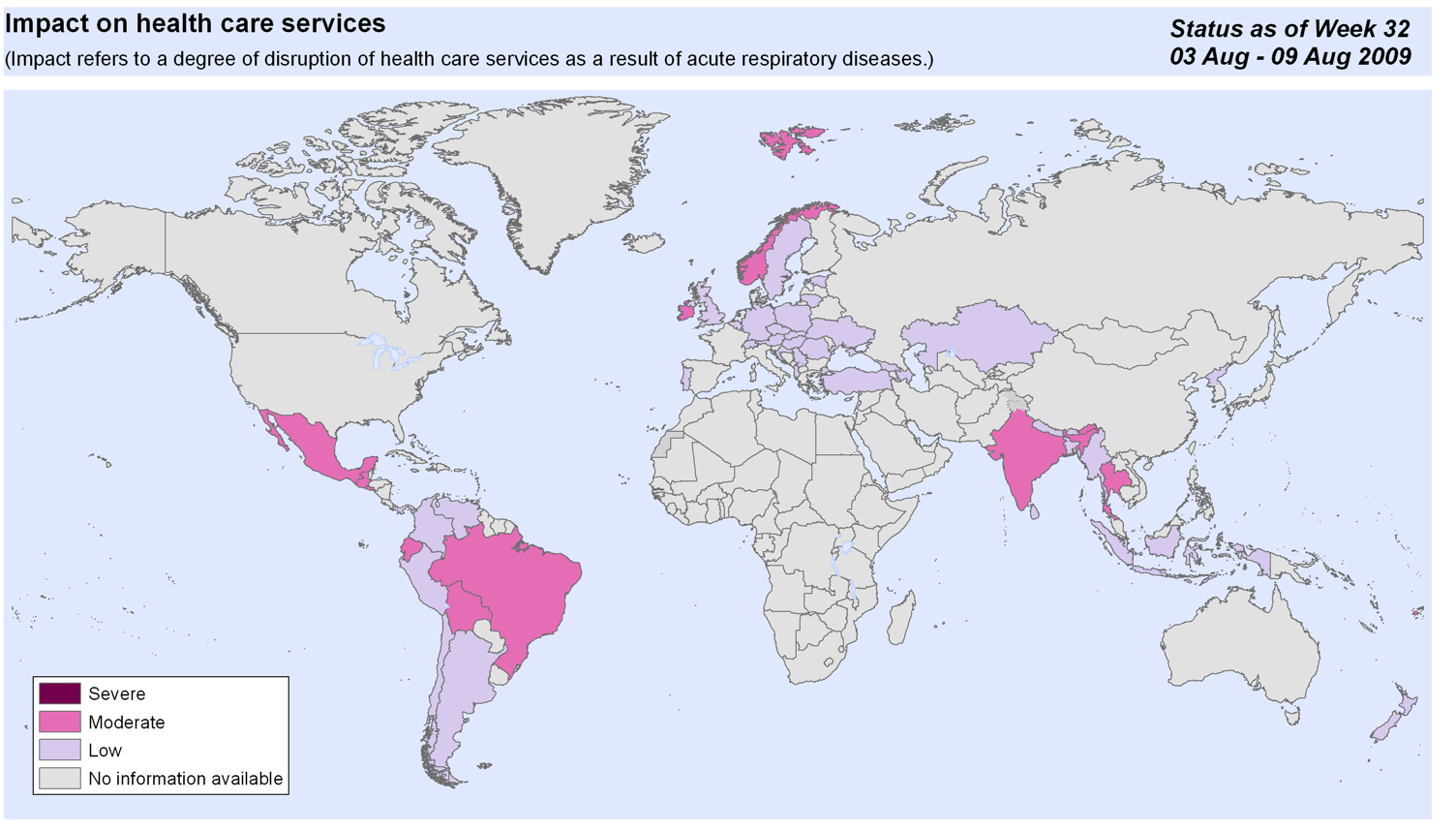
WHO: Impact on healthcare services

Swine flu has now been around for about 6 months.It has caused an alarming impact on health services trying to cope with all thr panicked populations, more so in Developing countries.
Mexico, India, and Central and Southern American countries have born the brunt.
Check the image.
H1N1fluImpact

27 August, 2009

Using Cellphones to diagnose Malaria and Blood disorders

Microscopy provides a simple, cost-effective, and vital method for the diagnosis and screening of hematologic and infectious diseases.It is an essential tool in disease diagnosis and widely used all over the world. Unfortunately, the EXPERTISE required to use the tool, and to evaluate the findings is not very common. One requires a pathologist with many years of experience to make sense of those seemingly random and confused pixels. (I know, i am a pathologist :-)


It takes a lot of effort, and money to train a pathologist, equip him/her with all the instruments required, and then use the skills in a backward area without proper facilities. But the advent of digital imaging has solved many of our troubles. Telepathology made sure that we do not need a pathologist physically present at the site, to render a diagnosis.

But microscopy and digital imaging of the biopsy/tissue fragment was still a hassle. Now we have done better. You don't even need a microscope to send a microscopic image over the network!! Researchers from the Univ. of California worked with high-powered LED – which retails for just a few dollars – coupled with a typical camera phone to produce a clinical quality image sufficient for detecting in a field setting some of the most common diseases in the developing world.


The newly developed technology, CellScope, allows for average cell cameras to be retrofitted with powerful microscopes, able to detect malaria parasites, and even fluorescent marker-stained tuberculosis bacteria.
Thus you have your humble cell-phone transformed into the sherlockian "cell-scope".

“The images can either be analyzed on site or wirelessly transmitted to clinical centers for remote diagnosis. The system could be used to help provide early warning of outbreaks by shortening the time needed to screen, diagnose and treat infectious diseases,” University of California in San Francisco (UCSF)/UCB Bioengineering Graduate Group graduate student David Breslauer adds. CellScope could also provide remote access to digitized health records, and would be amenable to epidemiological studies, using triangulation or global positioning system location data, such that outbreaks could be monitored as they happen.

So maybe i could click a photomicrograph of that mole on my friend"s forearm, twitter it to my onco-pathologist friends, who view it on their smartphones and twitter / message their diagnosis back to me. Simple and fast, especially with my own group of pathologists on the network.


Labels: , ,


Related articles

Posted via email from drneelesh's posterous